Letter from the Editors: Art and Authoritarianism
Jonah Raskin
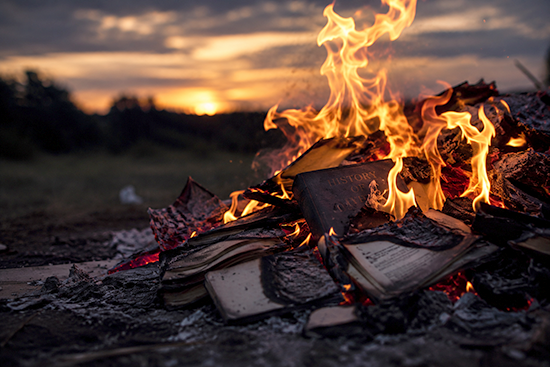
This summer 2026 issue of Caveat Lector exemplifies and accentuates E. M. Foster’s notion expressed in Aspects of the Novel that while history usually makes a mess of things, artists and writers create works of beauty and truth that defy authoritarian rule and state censorship. Foster’s observation seems as true for the era of the French King Louis XIV and the playwright Moliere as it is for Stalin’s Russia and the symphonies of the composer Shostakovich, as well as for Donald Trump’s nasty version of the U.S. and the nearly two dozen contributors to our latest issue, beginning with a photo by co-editor and founder Christopher Bernard.
Of course, gulags and prisons, brute force and police states take a toll on the creative spirit. Writers and artists censor themselves, remain silent and go into sterile exile. But they also find ways to express themselves in allegory, fable, science fiction and fantasy. Think of Jonathan Swift’s Gulliver’s Travels, Kurt Vonnegut’s The Sirens of Titans and Cat’s Cradle and Samuel Butler’s Erewhon (that's the word “nowhere” spelled backward). Imaginative works of fiction take readers away from the world and into outer space and to distant times and then return them to the world with insights and renewed courage.
The creative drive seems to be unstoppable.
The McCarthyism of the 1950s hammered away at writers like Dashiell Hammett, one of the fathers of noir fiction, who went to jail rather than name names, but he and others survived and even thrived; the Maltese Falcon has outlived and out-distanced the investigators. Screenwriter Dalton Trumbo was blacklisted, along with the members of Hollywood Ten, but Trumbo and the Ten made dramatic comebacks with scripts for movies such as Spartacus. James Cain’s novels, including The Postman Always Rings Twice, were banned in Boston, but banning backfired; Cain’s novel became a bestseller.
In San Francisco, copies of Howl were confiscated by the authorities; the publisher Lawrence Ferlinghetti went on trial for obscenity, but the trial and the verdict of not guilty provided free advertising for the book, for the author, for City Lights Bookstore and its founder.
But how many books have remained unpublished? How many singers and songwriters have been silenced? Victor Jara – a Chilean folk singer, poet, and political activist – was arrested in 1973 when the government of Salvador Allende was overthrown by a military coup. Jara was tortured, shot, and killed, but Chilean refugees created peñas* in Mexico, the U.S. and elsewhere and carried on the culture he helped to create.
I’ve always thought that Nathaniel Hawthorne set his novel The Scarlet Letter in Puritan New England as a kind of ploy to dismantle the Puritanism of his own day. And I’ve liked to think that Herman Melville took his narrator Ishmael, in Moby-Dick, along with the crew and captain of the Pequod to the vast reaches of the Pacific to explore the obsessive, self-destructive nature of capitalism.
Tillie Olsen writes about Melville in her pivotal book Silences (1978), which novelist Margaret Atwood, author of The Handmaid’s Tale, hailed as “a scrapbook, a patchwork quilt… joined to form a powerful whole” that describes “the ideal conditions for creation as perceived by the writers themselves, and almost every imaginable impediment to that creation.” Olsen herself was silent for decades after publication of innovative work in the 1930s. She made a major comeback with Tell Me a Riddle in the 1960s, when she was hailed as an innovative voice in American literature.
In the current issue of Caveat Lector, poets outnumber fiction and non-fiction writers. They include Paula Appling, Christopher Bernard, Richard deFuria, Dan Grote, David Harrison Horton, Carl Landauer, James B. Nicola, Andy Roberts, Kelley Jean White, and myself. Our own Steven Hill weighs in with two poems, “Dusk to Dawn” and “The Hourglass.” There are also poetry readings by Bernard, Nicola, and yours truly.
Artist Natalie Craig takes viewers to Greenland – which is coveted by Trump – with sketches she made after a recent voyage to the world’s largest island. Using words and photographs, Dion Dennis transports readers to Laredo, Texas, the city that sits on the U.S. frontier with Mexico and where a whole culture had been destroyed. Robert Daeseler dives back in time and writes about Anthony Trollope, Charles Dickens, and Victorian realism, which altered the nature of the English novel.
Thomas Riesner contributes some spooky yet friendly paintings in our art section. Our fiction pieces concern societal upheaval: some worlds imagined, as in Ho Lin's dystopian fantasia "Signal Break," some very real and in the moment, as in Jhon Sánchez's "Two-Birthday Boy," and some a hair away from happening, as in Ace Boggess's world without women in "Day of Remembrance."
We're doing our best to publish the best in contemporary fiction, nonfiction, poetry, photography, and art. Maybe the work in the current issue will take you away from the troubles of the world, sustain you and nourish you, and take you back to the big bad world rejuvenated. We sincerely hope so. Finally, Bernard offers a heartfelt tribute to our recently departed friend Robert Balmanno, whose series of futurist novels, The Blessings of Gaia, appeared under the “Caveat Lector Book” imprint. May his spirit help us to carry on in these times of darkness – and light.
---
*The literal translation of the Spanish word peñas is rock or crag. It’s also a cultural term that can mean social club or café. The Berkeley peña on Shattuck Avenue that calls itself a “multicultural center,” providing a space where social activists, artists and entertainers have gathered since it was founded in 1975 by refugees in flight from General Augusto Pinochet’s dictatorship.
Image: Allen Ginsberg reading Howl at the 6 Gallery in San Francisco
Jonah Raskin is Caveat Lector’s non-fiction editor. His newest published work is Keeping the Beat Alive, a Caveat Lector book, that includes his essays and reviews about the Beat Generation writers and their circle, and Isolato, a collection of his poems written in San Francisco, 2020–2026.